Actor Paget Brewster has found herself at the center of online controversy after a heated social media exchange with a television critic drew widespread attention. The incident began after a review of Criminal Minds: Evolution criticized the show’s shift from traditional 20-plus episode network seasons to shorter streaming-era formats. The review, published by ScreenRant writer Shealyn Scott, argued that the structural change ultimately weakens the show’s impact on Paramount+.
The critique itself was relatively standard industry commentary, but it quickly escalated when Brewster responded directly on X, formerly Twitter. Her reaction surprised many fans, as it shifted from defending the series to personally targeting the reviewer. Within hours, screenshots of her post began circulating widely, sparking debate about the boundaries between creators, critics, and public discourse.
The Original Review That Triggered the Response
The controversy stems from a ScreenRant piece by senior writer Shealyn Scott, which focused on how Criminal Minds: Evolution adjusts its storytelling approach under streaming constraints. The review noted that while the show retains its core characters and tone, the reduced episode count limits narrative depth and procedural rhythm that long-time viewers associate with the franchise.
Scott’s criticism was not an attack on the cast or production team, but rather a structural analysis of how the series has evolved under Paramount+. However, Brewster appeared to interpret the critique more personally. She responded on X with a strongly worded message aimed at the reviewer, writing:
“You’re young. You don’t know that bad pics and bad reviews can lead to 350 people losing their jobs. Sell vintage. Work at a shelter. Do something better than what you do now. Because right now you suck.”
The post immediately drew backlash from users who felt the tone was disproportionate to the criticism being made. Others defended Brewster, arguing that actors often face pressure when negative reviews affect perception of a show.
Backlash and Correction From Paget Brewster
As the post spread, many pointed out that the “bad pics” referenced by Brewster were standard promotional stills distributed by the network for press use, not materials chosen independently by the critic. This detail added further scrutiny to her comments, with some industry observers noting that frustration may have been misdirected at the wrong target.
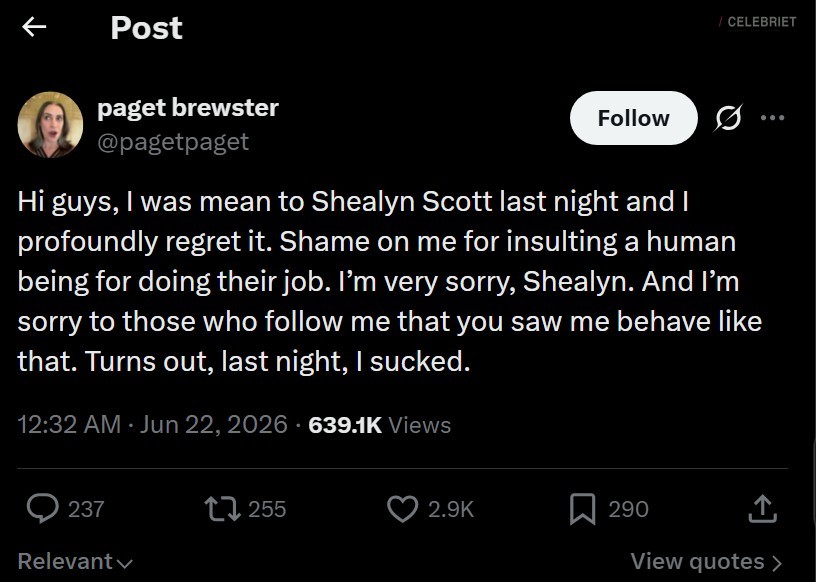
Within a short time, Brewster issued a public apology, again shared on X. Her follow-up statement, in which she acknowledged her response had crossed a line:
“Shame on me for insulting a human being for doing their job. I’m very sorry, Shealyn. And I’m sorry to those who follow me that you saw me behave like that. Turns out, last night, I sucked.”
Her apology marked a clear reversal from her earlier stance, and it softened some of the immediate backlash. However, the exchange has continued to circulate as an example of how quickly online disagreements between public figures and journalists can escalate.